Showing posts with label Springs. Show all posts

Sunday, July 21, 2019

Home Maintenance Checklist for Seminole County Homes

Florida Home Inspector’s Home Maintenance List


Florida Home Maintenance Schedule First Choice Home Inspections (386) 624-3893


You should not fool yourself, home maintenance is work and must be completed to keep your home in top shape and prevent extensive and expensive repairs in the future.  Whether you complete the task yourself or hire a professional to complete them; it is imperative the maintenance is completed in a timely manner.

Carrying out your monthly maintenance helps your home’s curb appeal and keeps your home safe and sanitary. Completing monthly, seasonal and annual tasks helps prevents damage to your home. It also helps to maintain or even increase your home’s real estate market value.

Completing your maintenance list will save you money on repair bills of your home’s systems and appliances. You can customize your home maintenance list to suit your home and accommodate your schedule.  You can print the list and have it laminated, use an app on your phone, add the items to your calendar or have an annual home checkup inspection by a licensed home inspector.

Ensure the task is within your level of experience or comfort.  Google or research the task for additional information and step by step instructions.  Never attempt a task that makes you uncomfortable.  Safety is the top priority when doing home maintenance.  Use the appropriate safety equipment; like wearing gloves and a face mask when undertaking certain tasks.  

If you need to hire a professional, try to plan the work when the season is slow;

  • Air conditioning / HVAC – late winter to early spring, avoid summer.
  • Roofing – winter to early spring, avoid summer or rainy season.
  • Chimney sweep – spring to summer, avoid fall and winter months.
  • Arborist / Tree service – winter months, avoid hurricane season.
  • Painters – winter to spring, avoid rainy season.

Monthly Home Maintenance Tasks


  • Check smoke detectors and carbon monoxide alarms and ensure you meet the minimum local requirements for these devices.
  • Test all GFCI outlets.
  • Test AFCI, GFCI and combination breakers.  Ensure sensitive electronic equipment is turn off before testing.
  • Remove the lint screen from the dryer lint trap and vacuum inside the trap.  Clean the lint screen with hot water and dish soap then air dry.  When clean, the screen should allow water to freely pass through the screen.
  • Clean oven hood filters.
  • Change your air conditioning filter(s).
  • Clean kitchen and bathroom drains and remove hair and debris.  Clean drain traps with equal parts of vinegar and baking soda.
  • Clean the garbage disposal with frozen lemons or cut wedges of any citrus fruit to remove odors.  Remove the baffle or splash guard and clean with soap and water.
  • Check the water softener and filtration systems; replace filters and replenish salt.

Quarterly Maintenance


Check your roof from the ground quarterly and after storms for damage.  1homeinspector.com
Detached and damaged tabs
  • Check your roof from the ground with binoculars for storm damage.  You should have a professional roof inspection every two years for routine roof maintenance.
  • *Clean the gutters of leaves and other debris. Check loose or missing gutter spikes or straps.  Downspouts should be secure and drain water away from your home.   Check joints and downspouts for damage or leaking.
  • Check faucet aerators and showerheads for mineral buildup.  Clean with CLR, Lime-Away or similar product.
  • Check doors, hinges, rollers, locks and knobs for deterioration or looseness.  Door should open, close and latch smoothly.
  • Open and close all windows.  Repair or replace any damaged balance springs and window hardware.
  • Carefully clean / vacuum refrigerator coils to remove dust to allow appropriate air flow.  Clean the drip pan, if equipped.
  • Check supply and drain plumbing under your sinks for leaks or corrosion.


Spring Maintenance


Cracked caulking - First Choice Home Inspections Home Maintenance list 1homeinspector.com
Dried out, cracked caulking.  Remove and replace.
  • *Clean your exterior siding with an appropriate outdoor siding cleaner.  Avoid high pressure washing as it can damage stucco, wood and even mortar between bricks.  For algae, mold and mildew select a cleaner with bleach or vinegar. 
  • Check your siding for cracks or moisture damage.   Stucco cracks under ¼” should be filled and sealed.  Over ¼” consult a licensed contractor.  Moisture damaged wood should be repaired or replaced.
  • Caulk around windows and doors to prevent air leakage.  Remove and replace any dried and cracked caulking.
  • Touch up exterior paint on siding and trim.
  • Replace smoke detector batteries.
  • Check and replace hurricane supplies. 
  • Clean and repair window screens.
  • Clean and inspect wood deck for loose boards and damage.  Replace any damaged wood.  Reseal or paint before summer rains.
  • Inspect your generator and lawn equipment for proper operation.  Replace any worn hoses, belts, filters or plugs.   Have all repairs completed before the summer rains or hurricane season.


Summer Maintenance


  • Fill and seal cracks in your concrete driveway and sidewalks.   Patch damaged asphalt driveways.
  • Check washing machine, refrigerator, dishwasher and hoses, risers and tubing.   A burst hose or riser could cause your home to flood.  Look for signs of worn or damaged hoses, leaks or corroded risers and tubing.
  • Check the fireplace for damage and have the flues professionally cleaned and examined.
  • Check all bathroom and kitchen caulking and grout.  Clean, repair and seal your tile grout.
  • Check and repair all leaking faucets and hose bibs.
  • Check and lubricate the garage door wheels and hinges.  Check the garage door opener and hardware are in proper working order.


Autumn Maintenance


  • Check and replace damaged weather stripping around doors and windows.  Check the insulation on the low pressure line on your outside air conditioning unit.
  • Check the smoke detector date on the back.  Replace smoke detectors over 10 years of age and with no date.  Replace smoke detector batteries.
  • Check and repair your home’s siding and trim for any damage or wood rot. 

Winter Maintenance


Raccoons nest in Heathrow attic.  Inspect your attic yearly for damage 1homeinspector.com
Raccoons in attic are dangerous
and should be professionally removed.
  • *Check your soffits for any damage.  Raccoons and squirrels will be looking for a nesting site and can damage attic insulation and electrical wiring.  Squirrels nesting season is February and August.  Nesting season for raccoons is usually in March. If you suspect or hear raccoons in the attic, call a professional wild life removal specialist, like Affordable Wildlife Removal to humanely remove and relocate the raccoon and kits.
  • *Check your trees for any dead or damaged branches.  Trim tree branches within 5 feet of your home to prevent damage to your home or roof.  Pay attention to the ground around the trees and look for any signs of root uplift.  Hire an arborist to remove any high limbs, limbs near your home or to evaluate dark staining, holes or sap on the trunk of the trees.  
  • Change the oil in your generator and lawn equipment.  Drain any remaining fuel from the tank, clean equipment and store.
  • Clean bathroom exhaust fan and HVAC duct covers.


Yearly Home Maintenance Tasks


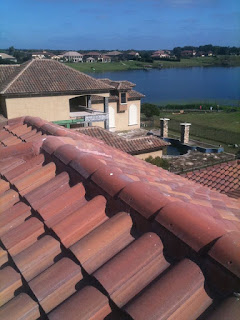
  • Have your roof professionally inspected by a Longwood Home Inspector. A home
    Longwood tile roof inspection by First Choice Home Inspections 1homeinspector.com
    A home inspector will
    perform an unbiased roof inspection.
    inspector will give you an honest, unbiased overview of the condition of your roof covering. A roofing company offers free roof inspections but they are there to sell you a new roof or make repairs.
  • Seal cracks. Sealing the cracks in your home’s foundation stops pests and water from intruding.
  • *Have your attic professionally inspected for signs of moisture intrusion or leaking, damaged or displaced insulation, leaking or damaged HVAC duct work, damaged or displace exhaust and dryer vents, and proper ventilation.
  • *Check all electrical receptacles, light switches, light fixture sockets, extension cords and appliance cords for deterioration or damage.   The electrical receptacle socket should hold the cord plug securely and should have no signs of overheating/blackening or melting.  Light fixtures should not flicker or have a damaged or worn socket.  Damaged or worn electrical receptacles and wiring may cause a fire and should be replaced by a licensed electrician.
  • Ensure all hand rails, balusters and banisters are secured in place and do not wobble.  Baluster spacing should be 4 inches or less.  Carpeting on stairs should be secure and not worn or frayed.
    Dryer vents fires are a leading cause of home fires.  1homeinspector.com
    Dryers - a leading cause of home fires.
  • Dryer ducts should be cleaned yearly or semiannually.  Wall vents are usually an easy homeowner project but goose-neck roof vents require professional cleaning.


Tasks that require the use of a ladder should be left to a professional
Ladder Safety
* - Tasks that require the use of a ladder or that involve electricity should be left to a professional.  Avoid tasks that you are uncomfortable doing.  Never use a ladder or pole saw within 10 feet of a power line.


Best Seminole County Home Inspector, Frank Carr of First Choice Home Inspections 1homeinspector.com (386) 624-3893

Frank Carr is the Owner / Inspector at First Choice Home Inspections in Deltona, FL serving Volusia, Seminole, Orange and Lake Counties. Formerly in the building trades, Frank’s focus is a safe home in the Orlando Metro and Daytona Beach areas of Central Florida and building FCHI. We believe that consumers have the right to expect the highest standards of thoroughness, fairness and effectiveness from their home inspector and that is exactly what we provide.
 
First Choice Home Inspections
Residential Home Inspections in Central Florida
(386) 624-3893 

Saturday, April 13, 2019

Home Construction in Central Florida is Booming

Orlando new home construction was up 51 percent in 2018 compared with the year before.  Construction was led by a surge in apartments but also increases in single family homes, townhouses and condos. Home builders started 16,238 single family homes last year, 12 percent more than 2017. Developers started 12,629 apartments, the most since the Census Bureau began tracking the statistic in 2004.


Orlando home construction is now at the highest level since 2009 when Obama took office. Home sales peaked in 2005 during the middle of the G.W. Bush administration and hit the bottom early in Obama's first term. Sales have since recovered, but are still at levels not seen since the early 1990s when G.H.W. Bush was leaving office.


Building material, skilled labor and lot shortages held new home construction down. Most of the skilled labor were retrained when unemployment peaked in in other fields and did not return when the economy improved.  Builders use of unskilled labor has them spending more time on repairs after the new homes are sold.


Our home inspection schedule has been full in part due to the number of re-inspections required on new home sales. Nationwide there is a labor shortage of 300,000 skilled workers like roofers and framers.


Concentrated urban areas of Orlando are adding homes at the fastest rate. Demand continues to be high in areas such as St. Cloud, Lake Nona, Western Orange County, Western Volusia and Lake County.


Frank Carr is the Owner / Inspector at First Choice Home Inspections in Deltona, FL serving Volusia, Seminole, Orange and Lake Counties. Formerly in the building trades, Frank’s focus is a safe home in the Orlando Metro and Daytona Beach areas of Central Florida and building FCHI. We believe that consumers have the right to expect the highest standards of thoroughness, fairness and effectiveness from their home inspector and that is exactly what we provide.
 
First Choice Home Inspections
Residential Home Inspections in Central Florida
(386) 624-3893 


Thursday, July 27, 2017

Radiant Barriers save Seminole County Homeowners Money

Orlando home inspection radiant barrier

What is a Radiant Barrier? Are they effective at reducing my energy bill?

We, First Choice Home Inspections, inspect a lot of hot dusty attics, some are 165° F. We see all kinds of situations where attic insulation is insufficient, ventilation is inadequate, and rarely find radiant barriers installed in attics. According to the Department of Energy Radiant Barriers work best in hot climates when used in conjunction with sufficient insulation and ventilation. Studies show that radiant barriers can reduce cooling costs 5% to 10%. The reduced heat gain may even allow for a smaller air conditioning system or improve effectiveness of an under rated systems.
Radiant barriers are installed in homes primarily to reduce summer heat gain and reduce cooling costs. Radiant barriers do not reduce heat conduction like thermal insulation materials. The barriers are comprised of a highly reflective substrate or foil that reflects radiant heat rather than absorbing it.

Heat Transfer

Like a cool spoon in cup of coffee conducts heat through its handle to your hand; heat travels from a warm area to a cool area by a combination of conduction, convection, and radiation. Heat flows by conduction from a hotter location within a material or assembly to a colder location. Heat transfer by convection occurs when a liquid or air, becomes lighter and rises. When liquid or air cools, it becomes heavier and falls. Radiant heat moves from hots surfaces and is absorbed by cooler materials or air. A car parked in the sun will absorb the radiant heat into the cars finish and transfer the heat thru the metal into the interior where it heats the air inside the car.

How Radiant Barriers Function

Most insulation materials work by slowing heat transfer. Radiant barriers and reflective insulation systems are designed to reduce the transfer radiant heat. Radiant barriers must have an air space to work. Radiant barrier are less effective when installed horizontally. Dust accumulation on the reflective surface reduces its reflective properties.
As the sun heats your roof, it makes your roof hot. The heat travels through the roofing materials to the attic side of your roof. It radiates the increased heat energy onto the cooler attic materials, the air conditioning ductwork and the ceiling of your home. A radiant barrier reduces the radiant heat transfer from the underside of the roof to the other surfaces in the attic.

Radiant Barriers help air conditioners cooling capacity

Radiant barriers are more effective in hot climates than in cool climates, especially when cooling air ducts are located in the attic. Some studies show that radiant barriers can reduce cooling costs 5% to 10% when used in a warm, sunny climate. The reduced heat gain may even allow for a smaller air conditioning system. In cool climates, however, it's usually more cost-effective to install more thermal insulation than to add a radiant barrier.

Frank Carr Home Inspector First Choice Home Inspections
Frank Carr is the Owner / Inspector at First Choice Home Inspections in Deltona, FL serving Volusia, Seminole, Orange and Lake Counties. Formerly in the building trades, Frank’s focus is a safe home in the Orlando Metro and Daytona Beach areas of Central Florida and building FCHI. We believe that consumers have the right to expect the highest standards of thoroughness, fairness and effectiveness from their home inspector and that is exactly what we provide.
 
First Choice Home Inspections
Residential Home Inspections in Central Florida
(386) 624-3893 

Sunday, November 27, 2016

Lake Mary Fireplaces, Furnaces and Heater Safety

It is approaching that time of year again when we will be firing up our heaters, fire places and furnaces.  Have you had your annual maintenance checkup or your fireplace chimney inspected and cleaned?  These are important things to consider, but did you forget to check your batteries in your smoke and CO alarms.  Most homes have smoke alarms (detectors); more than 33 percent of these homes are not protected because the smoke alarms don’t work.  When a smoke alarm fails to work, it is frequently because the batteries are missing. People often remove or disconnect batteries to prevent nuisance activation caused by bathroom steam or cooking vapors.  Was your smoke alarm on a recall list?

Smoke and Fire

Most fire deaths occur in the middle of the night.   No smoke alarms were present or they did not operate in nearly 75% of residences where a fire fatality occurred, according to FEMA statistics.  A smoke alarm is the most valuable life saving device you can have in your home.  An operable smoke alarm will reduce your chances of dying in a fire, nearly in half.  Smoke alarms are designed to detect and warn that silent, but deadly smoke is in the air. The early warning will wake you and your family, allowing time to escape your burning home.
At 40 percent, cooking is the leading cause of residential structure fires. Heating causes another 14 percent. These percentages (and those that follow) are adjusted, which proportionally spreads the unknown causes over the other 15 causes.
The two leading causes of residential fatal fires are smoking, at 18 percent, and other unintentional or careless actions, at 14 percent. The leading cause of residential fires that result in injuries is cooking (26 percent), followed by other unintentional or careless actions (11 percent) and open flame (also 11 percent). Cooking is, by far, the leading cause of fires with property loss, at 20 percent.1
1  U.S. Fire Administration/National Fire Data Center, Fire in the United States 2003-2007 Fifteenth Edition

Carbon Monoxide

People are at an increased risk of carbon monoxide poisoning during the winter months. Well-insulated, airtight homes and malfunctioning heating equipment can produce dangerously high and potentially deadly concentrations of carbon monoxide.
Carbon monoxide is a by-product of incomplete combustion, any fuel-burning appliance, vehicle or tool that is inadequately vented or maintained can be a potential source of carbon monoxide gas.
Examples of fuel- burning equipment include: 
  • Fuel - furnaces and space heaters. 
  • Propane or Gas - fireplaces, (both vented and ventless), space heaters, ranges and ovens, clothes dryers, grills, smokers, and deep fryers.
  • Wood burning fireplaces and stoves 
  • Charcoal grills and smokers 
  • Gasoline – automobiles, lawnmowers and power tools
Gas fireplaces are gaining in popularity based on their low cost, convenience and relative ease of installation.  Ventless or vent free gas fireplaces are not vented to pipes or chimneys. The burned gases including carbon monoxide are put into the circulation of the air within your home.  Based upon the health risks associated with the use of ventless gas fireplaces, their installation is illegal in many areas of the country.
Prevent or minimize the potential for exposure to carbon monoxide gas. 
  • Have your home-heating systems, fuel-burning appliances, flues and chimneys inspected, cleaned or schedule an annual home checkup by a qualified home inspector. 
  • Make regular visual inspections of fuel-burning appliances such as your gas dryer and hot water heater. 
  • Do not burn charcoal inside a home, cabin or camper.
  • Do not operate gasoline-powered engines (generators, cutting saws) in confined areas such as garages or basements. 
  • Do not idle your car inside the garage. 
  • After a hurricane or storm, make sure vents for the gas dryer, furnace, stove and fireplace are clear of debris and intact. 
  • Never use gas ovens and ranges to heat your home!
Check your Smoke and CO alarms frequently.  Smoke alarms are set off by bathroom steam or cooking vapors. Rather than take the battery out of your alarm, do the following: 
  • Quiet the alarm by pushing the “HUSH” button, if equipped. 
  • Open windows and turn on vent fans to clear the air.
  • Consider relocating the alarm farther away from the cooking area or bathroom.
  • Consider installing a photoelectric or combination photoelectric/ ionization type alarm. The photoelectric and combination type alarms are less sensitive to cooking smoke.

Causes of Christmas Fires

Cooking, heating, and open flames are the major cause of Christmas fires, according to the US Fire Administration.  This is not surprising due to holiday cooking and the more prevalent use of home fireplaces, displays, and decorations involving candles.  The daily incidence of candle−started fires quadruples on Christmas Day.
home inspection, fire, home, home inspector, Lake Mary, FL, Seminole County, Florida, Debary, Orlando, Longwood, Sanford, Oviedo, Winter Springs, Wekiva Springs,

Opinions of a Home Inspector

Christmas is the time to spend with your family and friends, not to worry and agonize if you will have a fire.  Every Christmas the sounds of fire engine sirens overpower my family’s holiday music.   We often worry if the sirens are for one of our friends or neighbors.  You should have all your heating and cooking equipment inspected and serviced before your family arrives.  Fireplaces should be inspected yearly and cleaned regularly.  Be aware of the placement of candles and decorations.  Make sure you give your live Christmas tree plenty of water and keep it away from candles and fire places.  May your Christmas be worry free and full of holiday cheer.


Frank Carr is the Owner / Inspector at First Choice Home Inspections in Deltona, FL serving Volusia, Seminole, Orange and Lake Counties. Formerly in the building trades, Frank’s focus is a safe home in the Orlando Metro and Daytona Beach areas of Central Florida and building FCHI. We believe that consumers have the right to expect the highest standards of thoroughness, fairness and effectiveness from their home inspector and that is exactly what we provide.
 
First Choice Home Inspections
Residential Home Inspections in Central Florida
(386) 624-3893